
March 2026
In optogalvanic spectroscopy experiments, a hollow cathode lamp is often powered through a series ballast resistor and the AC optogalvanic signal is picked up with a coupling capacitor on the lamp electrode that is connected to the resistor. While this circuit is simple, it is not good for two reasons: first, the resistor needs to dissipate a lot of power and heats up in order to maintain the required lamp current, and second, unless the resistor value (and the corresponding voltage and power dissipation) become unreasonably large, the resulting low impedance attenuates the optogalvanic signal.
A better way is to power the lamp through a constant-current sink which ideally presents an infinite impedance. Such a ballast therefore does not attenuate the optogalvanic signal, and additionally the power supply voltage can be reduced so that only a few volts (or even less) are present across the ballast which results in higher efficiencies with most of the electrical power delivered to the lamp.
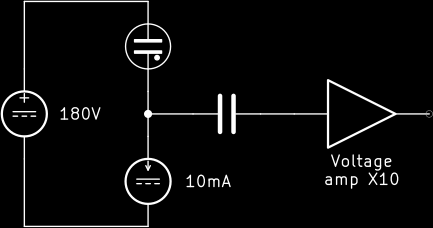
The ignition voltage of hollow cathode lamps exceeds their operating voltage by several dozen volts, so the initial power supply voltage should be sufficiently high to cause ignition, and then lowered to reduce power dissipation in the current sink. It is also important that during normal operation the anode of the lamp be held at a constant, low-noise voltage; otherwise the fluctuations would couple through the lamp and get amplified, resulting in noise at the output.
I built a quick-and-dirty prototype to try out this idea. A low-cost "Rainworm" 300V 1A lab power supply was used as a high voltage source, which was filtered through a resistor and a high-voltage electrolytic capacitor. Those cheap power supplies are particularly noisy and the RC filtering remained somewhat inadequate; substantial ripple from the power supply was still detected at the output of the amplifier. A high-frequency boost converter (such as those developed by the Nixie tube community) followed by a BJT-based capacitance multiplier should provide better performance. The current sink was built using a KSC5026 NPN transistor with a 390 ohm resistor in the emitter and the base held at a constant and filtered 5V. It is again important that the base voltage source be low-noise, as any voltage noise here would result in current noise through the lamp and voltage fluctuations at the amplifier input. The amplifier was a AD620-based circuit, with an input impedance of 1Mohm and a gain of 10, which was coupled to the lamp with a 100nF capacitor and a current-limiting resistor of 3.9kiloohm. To reduce noise, the current-limiting resistor should be kept as small as possible; it should simply allow the AC-coupling capacitor to charge and discharge during high voltage transients without blowing up the amplifier's input protection diodes.
When tested with the barium hollow cathode lamp and 493nm laser described in previous articles, the performance of this prototype was so good that the optogalvanic spectroscopy signal was easy to see directly on an oscilloscope, without the aid of a lock-in amplifier. Of course, this circuit can be used with Soundlocker to achieve superior results.